
 English
 Español
 Français
 Deutsch
 Italiano
 Português
 العربية
 Русский
 日本語
The need
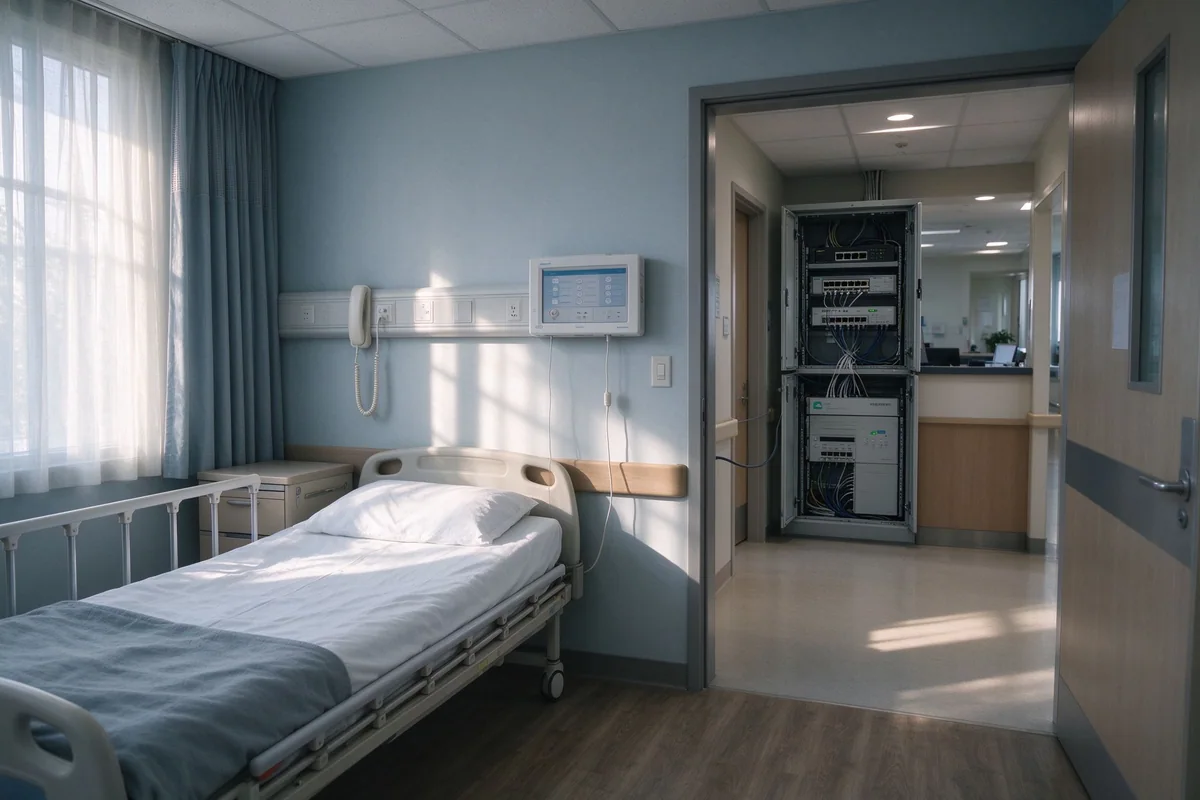
The home has ninety beds over three wings, six floors of rooms, bedside call units and pull cords in every room, staff tablets on Wi-Fi and door control at the entrance and the drug store. The call units need power at the bedside, and the night staff cannot have a bell delayed behind a tablet update or a camera stream. The previous network also mixed the office printers and the manager's PC into the same segment as the call system.
What was specified
| Model | Qty | Role in the project |
|---|---|---|
| RS1024K-P24-4S-M | 3 | Wing cabinet, 24 PoE ports for bedside units, corridor cameras and door controllers |
| RS1008K-P8-2S-M | 6 | Floor PoE for bedside clusters and Wi-Fi access points along each corridor |
| RPS-3164QG | 2 | Entrance and office cabinet for the door control and management positions |
Why that split
One PoE switch per wing gives every bedside unit power and a managed port, so a failed unit shows up at the desk instead of being found on a night round. The floor units carry the bedside clusters and the access points, which keeps the cable runs inside the corridor. The call system gets its own VLAN with traffic priority, so neither a tablet update nor a camera stream can hold a bell behind it, and the office positions sit on a separate small switch rather than on the clinical segment.
Result
- A bedside unit that loses power is visible at the desk before the night round finds it.
- Call traffic has priority, so a tablet update cannot delay a bell.
- Office printers and the manager's PC are off the clinical segment.
Quantities in the table are the planned build, not a bill of materials for a specific tender.
