
 English
 Español
 Français
 Deutsch
 Italiano
 Português
 العربية
 Русский
 日本語
The requirement
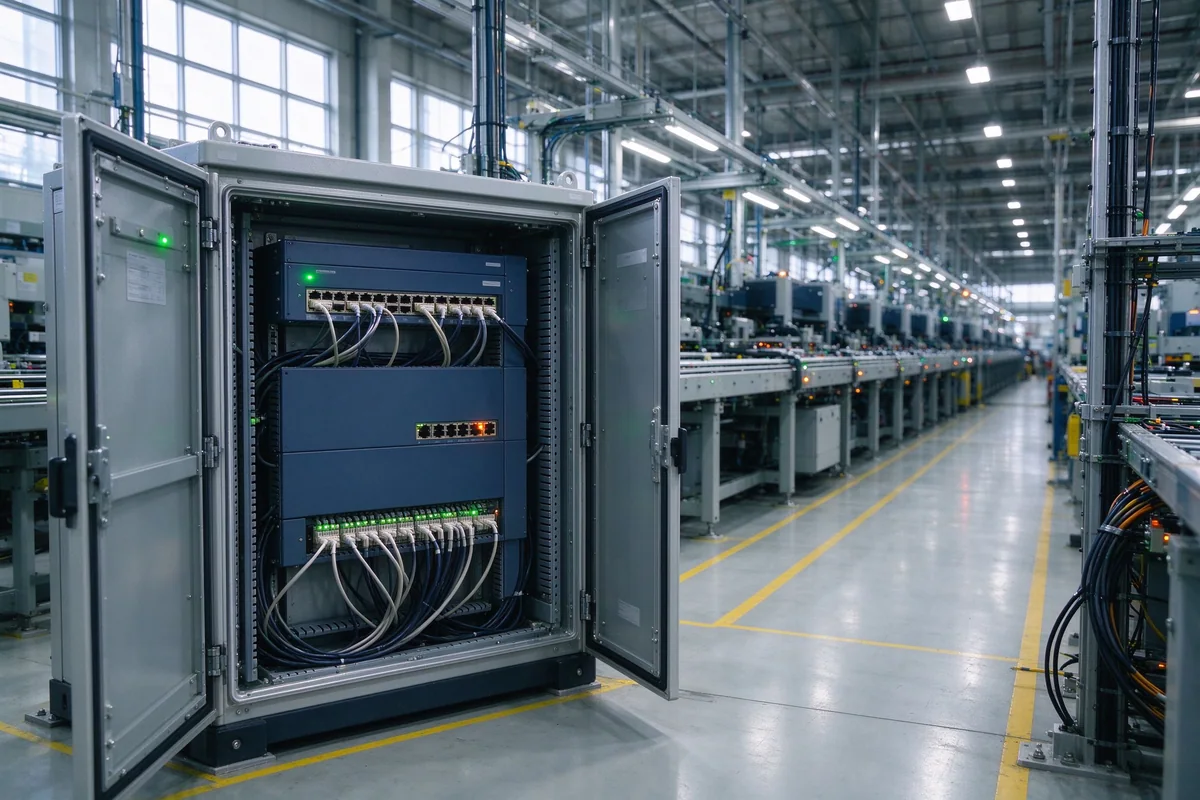
The plant floor had 14 machine cells on copper links up to 90 m, a cabinet that reached 55 °C in summer, and a substation room 400 m away that had to be on the same network. The previous installation used office switches in a sealed cabinet; two of them failed within a year and one failure stopped a line for half a shift.
What was specified
| Model | Qty | Role in the project |
|---|---|---|
| RIS1000-16G-2F | 6 | 16-port industrial switch with 2 fibre ports, ring node per cell group |
| RS1004K-2S-I | 4 | 4-port industrial PoE for sensors and IP cameras at the cell |
| RS1001KP-1S | 2 | PoE optical converter for the 400 m link to the substation room |
Why this split
The ring nodes carry the traffic that must not stop, and the fibre pair lets a cable fault close the ring instead of splitting the floor. The small 4-port PoE units sit inside the machine cells, where a 16-port chassis would not fit and where only two or three devices need power. The converter pair carries the substation room over fibre, so the distance stops being a copper-length problem and becomes a fibre-budget problem.
Result
- Cabinet temperature is no longer a switch specification question: fanless industrial units rated for the enclosure temperature replaced the office switches.
- A fibre cut on one ring segment is now a redundancy event, not a line stop.
- The substation room joined the plant network without a second copper run or a media converter from another brand.
Customer and site details are anonymised. Ring configuration and temperature rating must be confirmed against the actual cabinet and cable schedule.
