
 English
 Español
 Français
 Deutsch
 Italiano
 Português
 العربية
 Русский
 日本語
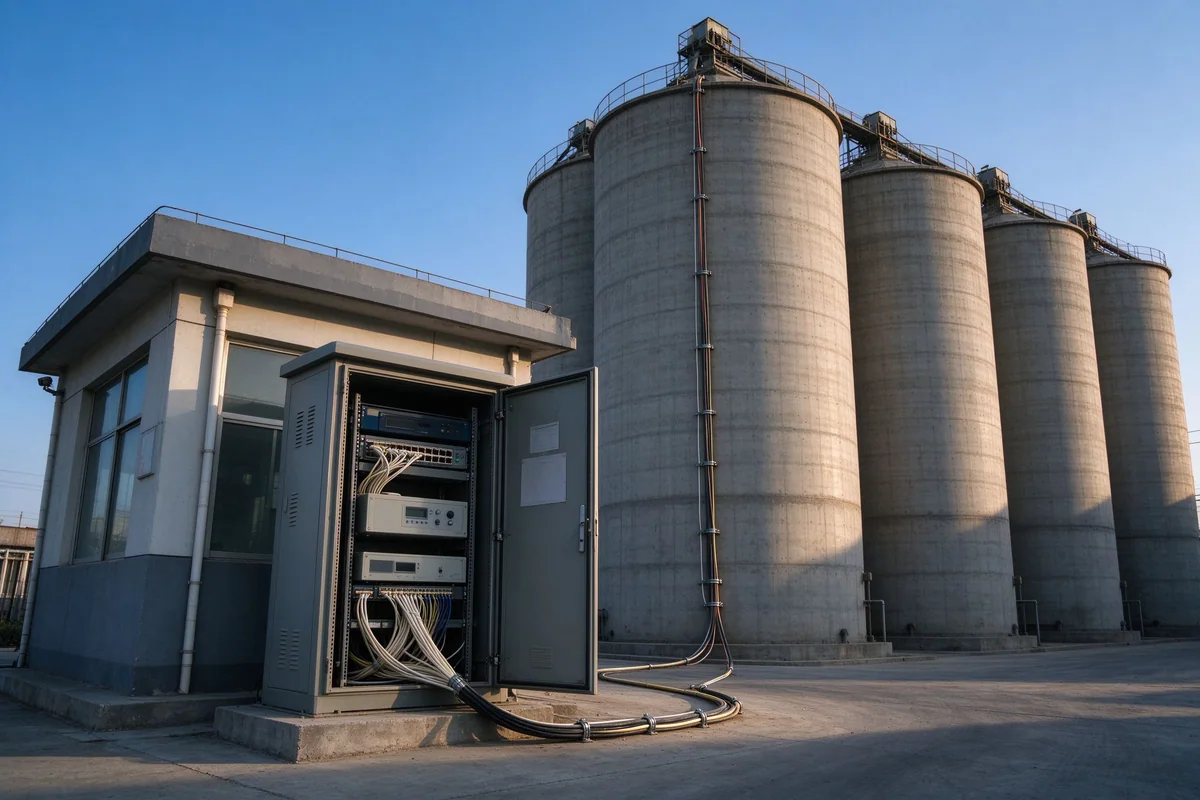
The need
The terminal stores grain in twelve silos of up to 4,000 t, each with temperature probes on a cable, a level sensor and a camera at the discharge. Probes were read by walking the site with a handheld, and the weighbridge shared a switch with the office, so a large transfer could interrupt weighing. The site wanted hourly readings through the intake season and the weighbridge isolated.
What was specified
| Model | Qty | Role in the project |
|---|---|---|
| RS1025K-8LG-2S-10G | 2 | Control room aggregation, 2.5G ports for probe and camera heads, 10G uplink to the office |
| RS1024K-8L-16S-M | 3 | Fibre fan-out in the silo block, sixteen fibre ports to the silos |
| RS1001KP-1S | 6 | PoE converter at the six silos beyond the fibre reach of the fan-out |
Why that split
Probe and camera heads are the only devices that need more than a gigabit, so they get the 2.5G ports, and the 10G uplink leaves the office link free for everything else. The silos are spread over a large site, so a fibre fan-out turns one control-room link into sixteen silo links and keeps copper out of the dusty runs. The furthest silos sit on converters because a switch at each of them would need a power feed and a cabinet for one camera and one probe.
Result
- Every silo reports on a schedule through the intake season instead of by handheld.
- Weighbridge traffic is isolated, so a large transfer cannot interrupt weighing.
- Camera and probe share one port at each far silo, with no cabinet on the silo top.
Quantities in the table are the planned build, not a bill of materials for a specific tender.
