
 English
 Español
 Français
 Deutsch
 Italiano
 Português
 العربية
 Русский
 日本語
The need
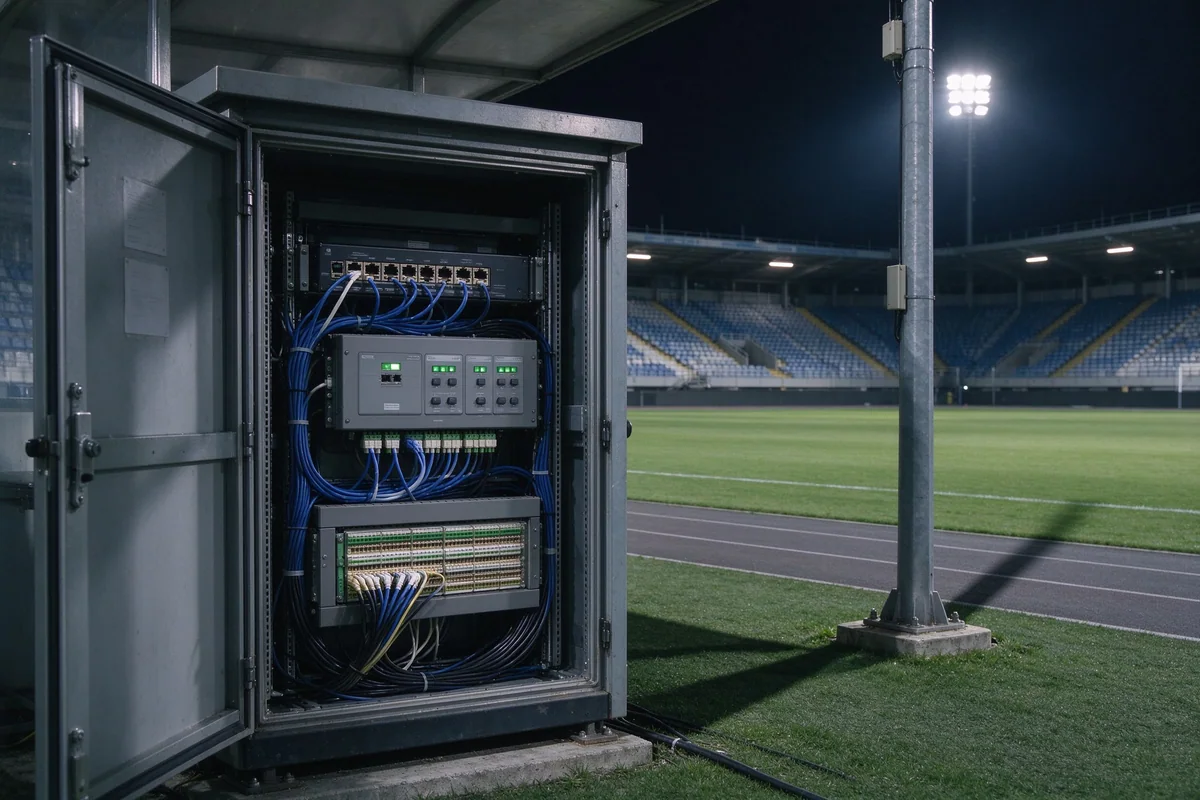
The ground runs four masts with 24 floodlights, a scoreboard, gate readers at two entrances and two pitch-side cameras for the video referee. Presets change between training, match and maintenance modes, and the broadcast crew arrives on match day wanting a clean feed with no other traffic on it. The old copper from the control room could not reach the masts, and adding a second network for the gates was not on the table.
What was specified
| Model | Qty | Role in the project |
|---|---|---|
| RS1024K-P16-2S-M | 4 | Mast-base cabinet, PoE for the camera and gate reader, fibre back to the control room |
| RIS1000-16G-2F | 2 | Control-room ring, sixteen gigabit ports, two fibre ports to the masts |
| RS1025K-8LG-2S-10G | 2 | Broadcast and streaming uplink, 10G SFP to the outside contribution link |
Why that split
The mast cabinet is where the distance problem is, so PoE and the fibre port go there, and the cameras and readers share it instead of getting a second run. The control room keeps a ring so a single fibre does not stop a match day, and the 10G uplink is kept apart because a broadcast feed competes with nothing else for bandwidth. Presets, access control and video sit on separate VLANs, so a camera reboot never touches the floodlights.
Result
- Preset changes are pushed from the control room before each session.
- Gate readers and pitch-side cameras share the mast cabinet without extra cabling.
- The broadcast feed has a dedicated VLAN and uplink on match day.
Quantities in the table are the planned build, not a bill of materials for a specific tender.
