
 English
 Español
 Français
 Deutsch
 Italiano
 Português
 العربية
 Русский
 日本語
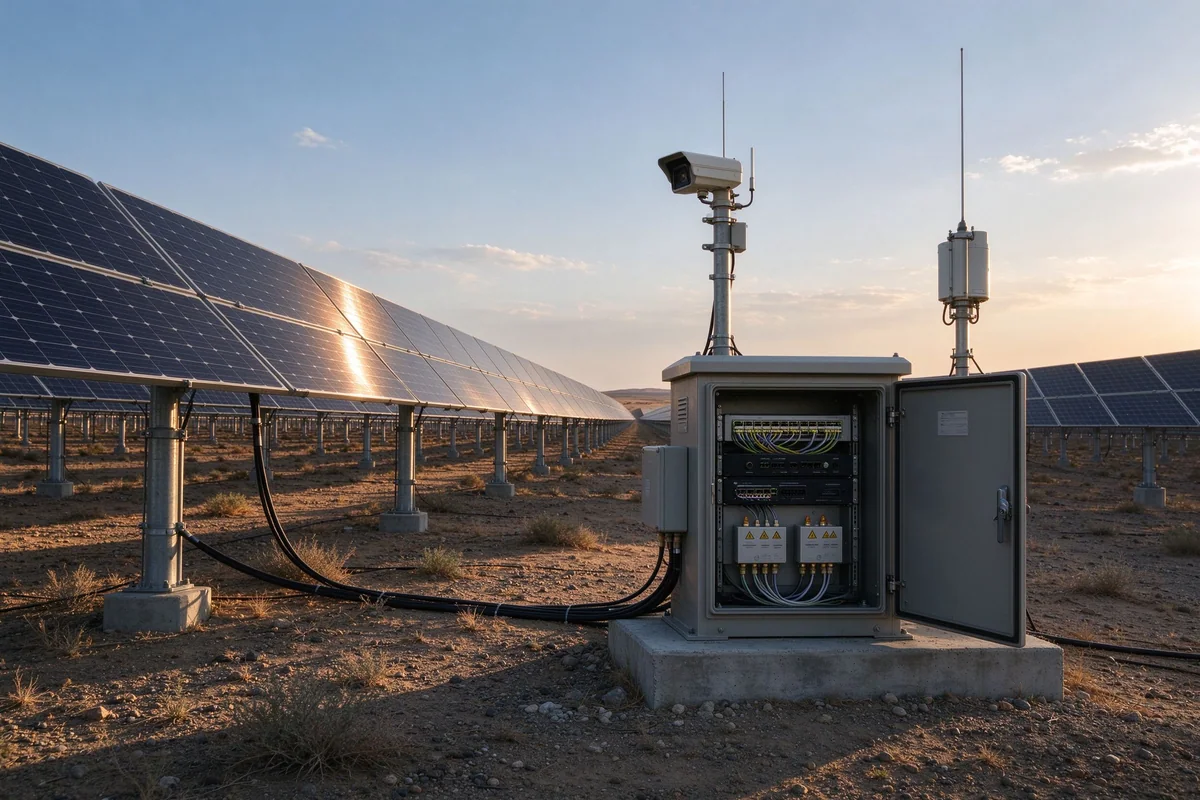
The need
The site's monitoring gateways sat in inverter cabinets with no active cooling, and summer cabinet temperature reached 60 °C. The previous network used commercial switches rated to 50 °C, and two had failed in the first summer. Camera coverage along the array rows was required for theft detection, and the rows are up to 900 m from the control cabin.
What was specified
| Model | Qty | Role in the project |
|---|---|---|
| RS1008K-2S-WI | 8 | Wide-temperature managed switch inside the inverter cabinets, fibre uplink |
| RS1024K-P16-4S-MI | 3 | Industrial PoE along the array rows for cameras and sensors |
| RS1001G-1S | 12 | Fibre converters for the long row-to-row spans |
Why that split
The cabinet switch is the piece that has to survive heat, so it was specified by temperature class rather than port count. PoE sits along the rows where the cameras are, behind a fibre link that keeps the copper run short. Converters bridge the row spans, which turns a distance problem into a fibre budget instead of a repeater chain.
Result
- Cabinet temperature stopped being the reason for outages; the units are rated above the measured summer maximum.
- Camera coverage along the rows without a second copper run per row.
- Row-to-row links are now fibre, so lightning-induced surges on long copper are no longer the failure path.
Client and site are anonymised. The configuration is a reference design, not a quotation; temperature class, surge protection and fibre budget must be confirmed against the site's measured conditions.
