
 English
 Español
 Français
 Deutsch
 Italiano
 Português
 العربية
 Русский
 日本語
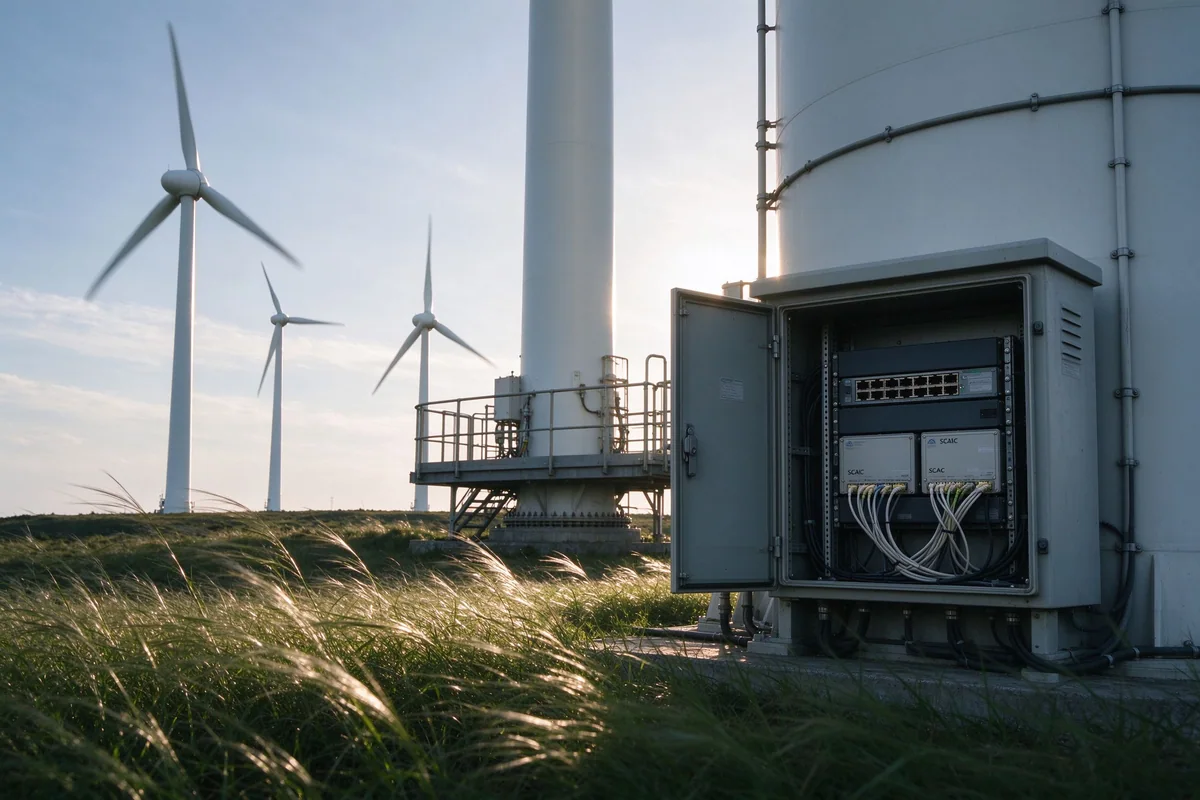
The need
The turbine bases sit several hundred metres apart along the ridge, and the original network was a daisy chain of copper that stopped working whenever the temperature dropped. Blade-inspection cameras were added later and had nowhere to plug in. There is no heated shelter at any tower, and the operator will not send a technician up the ridge for a single switch.
What was specified
| Model | Qty | Role in the project |
|---|---|---|
| RIS2000-8GP-2FM | 9 | Turbine-base PoE and fibre: inspection camera, vibration gateway, two fibre ports into the ring |
| RS1008K-2S-WI | 1 | Ridge collector in the substation, wide-temperature, joins the ring to the control room |
| RS1001KP-1S | 4 | PoE media converters feeding the met mast and the two gate cameras |
Why that split
Single-mode fibre replaces the copper chain because the spans are far beyond what copper can carry and the ridge is a lightning target. Every base gets a managed switch so a failed link is recovered on the ring rather than by a site visit, and the PoE ports power the cameras without a separate supply in an unheated cabinet. The wide-temperature models are the reason no enclosure heating was added, which keeps the installation to one box per tower.
Result
- SCADA polling survives a link cut: the ring reroutes while the operator watches.
- Blade images reach the control room over the same fibre as the telemetry.
- One cabinet per tower, no heaters, no extra power feeds.
Quantities in the table are the planned build, not a bill of materials for a specific tender.
