
 English
 Español
 Français
 Deutsch
 Italiano
 Português
 العربية
 Русский
 日本語
The need
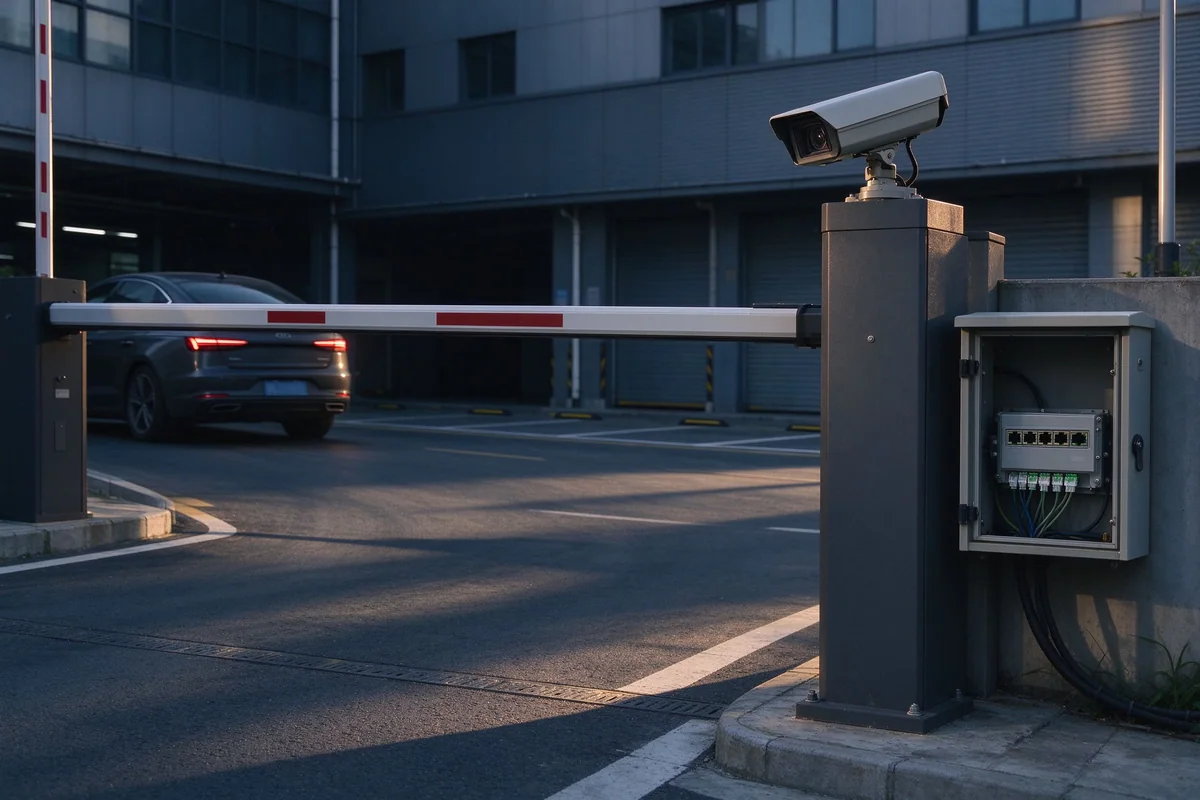
The operator wanted ANPR at eight lanes and barrier control on the same network. Lane equipment sits outdoors, and the site had already lost two cameras and a switch to a summer storm. The longest lane is 220 m from the booth, past the copper limit.
What was specified
| Model | Qty | Role in the project |
|---|---|---|
| RS1008K-P8-4S-10G-M | 4 | PoE edge at each lane pair, 10G SFP+ back to the booth |
| RS1024K-P24-4S-M | 1 | Aggregation and PoE in the control booth, VLANs for ANPR and barriers |
| RS1001KP-1S | 2 | PoE fibre converter for the 220 m lanes |
Why that split
Power belongs at the lane, not in the booth, so each lane pair gets a small PoE edge with an SFP+ uplink. The booth switch aggregates and keeps ANPR traffic off the barrier VLAN. The two distant lanes are fed by fibre, which removes the copper-length risk and keeps the surge path short at the lane end.
Result
- Lane power and network are one cable run, with the surge exposure kept at the lane cabinet.
- ANPR and barrier control are separate VLANs, so a camera fault cannot take the barriers down.
- The two long lanes no longer need a repeater or a second cabinet.
Client and site are anonymised. The configuration is a reference design, not a quotation; surge protection, earthing and lane distances must be confirmed by site survey.
